This article has been researched and written by Yassine Tayie. AI has not been used in producing this article.
We often throw around words like panic, stress, and anxiety as if they were the same. They’re not. Each taps into a very different part of how we react to life.
To make this more vivid, let’s borrow a symbol from the natural world: the praying mantis. You might know this insect for its graceful, prayer-like posture – but there’s a darker side too. In some species, the female praying mantis devours the male during or after mating. Desire and danger, attraction and death – all tangled together.
Let’s dive in.
A perfect creature to help us explore what happens when our emotions take over.
Panic: When Your Body Takes Over
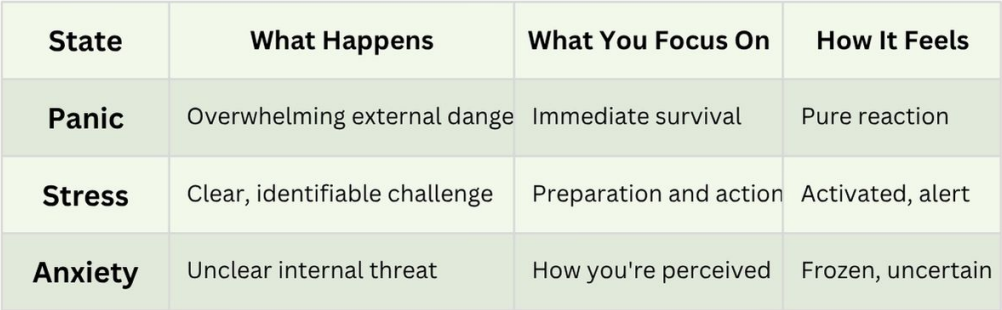
Panic hits when you’re faced with an overwhelming external situation – something you weren’t ready for, couldn’t predict, and don’t have the codes to handle. It’s what happens in the heart of a traumatic event: an earthquake, a car accident, sudden violence. Example: You walk into a room, wearing your male praying mantis mask. A giant female mantis – three meters tall – appears, moving sharply, making unsettling sounds. Every signal in your body screams danger. That’s panic. There’s no time to think. You don’t wonder who you are. You don’t wonder how she sees you. Your body takes over: it will either freeze, flee, or fight. A pure, instinctive response to something too overwhelming, too fast.
Stress: When You Know What You’re Up Against
Stress is different. It’s a response to a pressure you can see, name, and prepare for. It mobilises you for action. Example: You walk into the room, still wearing your male mantis mask. You spot a female mantis. You know enough about mantises to know the risk – but you also know what to do. Stay alert. Move carefully. Plan your escape. You’re stressed – but you’re moving. Stress sharpens you – up to a point. The goal is to get just enough stress to fuel action – not so much that it paralyzes you, like too much coffee tipping into insomnia.
Anxiety: When the Danger Is Inside You
Anxiety is trickier. It doesn’t arise from a clear external threat. It comes from the inside – from uncertainty about yourself, your position, your meaning. Example: You walk into the room, mask on. Across from you stands the giant mantis – but this time, she’s not moving. She just stares.
You can’t tell if she’s male or female. You don’t see any clear signs of danger – yet you know enough about mantises to know it could still cost you your life.
And then it hits you: You don’t even know what mask you’re wearing.
You don’t know how the mantis sees you:
You’re not panicking – there’s no sudden move – but you’re caught. Caught trying to read the mantis’ intention. Caught wondering what you are in her eyes. That’s anxiety. Anxiety grows not because of what the Other does, but because you’re trapped trying to guess your own position – stuck between possibilities, with no clear answer. The more you stare at the mantis, hoping for a sign, the more anxiety tightens its grip.
The Way Out
The solution isn’t to wait for the giant mantis to make the first move – to give you a response. It’s to turn inward. To ask yourself: “Before I walked into this room, what mask was I wearing?”
Reconnecting with who you are – before the gaze of the Other froze you – is what helps anxiety loosen its hold.
Final Thought
Panic pulls you into survival. Stress pushes you into action. Anxiety freezes you in uncertainty — unless you turn inward, back to who you are. Because sometimes, the real danger isn’t what stands before us. It’s forgetting ourselves under the gaze of the world.