ADHD vs ADD: What’s the Difference? [2026 Updated Guide]
This article has been researched and written by Mariam. AI has not been used in producing this article.
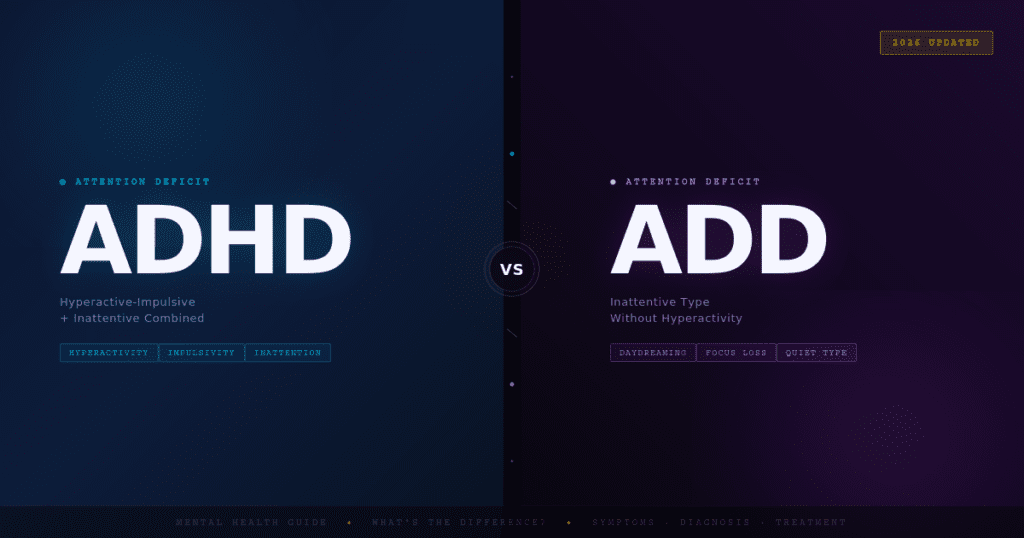
ADHD — Attention-Deficit/Hyperactivity Disorder — is the only official clinical diagnosis. ADD is not a separate condition: it is simply an older term that was retired in 1987. If you or your child has been labelled with ADD, you are almost certainly dealing with inattentive-type ADHD. The confusion is entirely understandable — the terminology changed, but the word ADD never disappeared from everyday conversation. This guide clears it up.
ADHD Meaning: What Does ADHD Actually Stand For?
ADHD meaning is Attention-Deficit/Hyperactivity Disorder — a neurodevelopmental condition affecting attention, impulse control, and activity regulation. ADHD meaning goes beyond simply “being distracted”: it describes a clinically recognised pattern where the brain’s executive functioning system works differently, affecting focus, organisation, memory, and emotional regulation. It is not a reflection of intelligence or effort. In Dubai’s international school environment, undiagnosed ADHD can quietly derail a child’s academic performance and self-esteem for years before anyone connects the dots.
The History of ADD vs ADHD: Why the Term Changed
ADD — Attention Deficit Disorder — entered clinical use in 1980 through the DSM-III. At the time, it described children who struggled with attention without significant hyperactivity. By 1987, updated research recognised that hyperactivity and impulsivity were core features of the same disorder for many people — and the DSM was revised to consolidate everything under the single diagnosis of ADHD.
Today, the DSM-5-TR — the current diagnostic standard used by clinicians in Dubai and worldwide — does not recognise ADD as a standalone diagnosis at all. What people still call ADD is now formally classified as ADHD Predominantly Inattentive Type. The condition is the same; only the language has evolved. Using the term ADD is not wrong in casual conversation, but clinically it no longer exists as a separate entity.
The Three Types of ADHD Explained
The DSM-5-TR defines three presentations of ADHD, each with a distinct profile of ADHD symptoms:
Type 1 — Predominantly Inattentive (formerly called ADD)
- Difficulty sustaining attention on tasks or conversations
- Frequently losing items, forgetting daily responsibilities
- Making careless mistakes; struggling to follow multi-step instructions
- Easily distracted by unrelated thoughts or stimuli
- Often quiet, internal, and easily overlooked — particularly common in girls
Type 2 — Predominantly Hyperactive-Impulsive
- Fidgeting, difficulty staying seated, constant physical movement
- Talking excessively, interrupting others, acting without thinking
- Difficulty waiting turns; impulsive decision-making
- The “classic” ADHD picture most people immediately visualise
Type 3 — Combined Type
- Significant ADHD symptoms of both inattention and hyperactivity-impulsivity
- The most commonly diagnosed presentation overall
- Requires evidence of both clusters across multiple settings
Key Differences in How Each Type Presents — And Who Gets Missed
The most important clinical distinction is not between ADD and ADHD — it is between the visible and invisible presentations of the same condition. Children with hyperactive-impulsive ADHD are typically identified quickly because their behaviour is disruptive in classrooms. Children with inattentive-type ADHD — the presentation previously labelled ADD — are far more likely to go undiagnosed, sometimes for decades.
Girls are particularly at risk. Globally and in the UAE, girls with ADHD are significantly underdiagnosed because they more commonly present with the inattentive type: they appear quiet, compliant, and “dreamy” rather than disruptive. They internalise their struggles as personal failings — poor concentration, forgetfulness, underperformance — before anyone considers that the root cause may be ADHD.
If your daughter seems bright but consistently underperforms, loses focus, or appears perpetually disorganised, a consultation with a child psychologist in Dubai is worth pursuing. Undiagnosed ADHD symptoms in girls frequently co-occur with anxiety — and an anxiety therapist with neurodevelopmental expertise can help identify what is driving the picture.
ADHD in Dubai: What the Data Says
ADHD is far more prevalent in the UAE than most parents and educators realise. Studies estimate it affects between 4.1% and 12.5% of school-age children in the UAE depending on the population studied. Crucially, research specific to the UAE (Khamis, 2011) found that the inattentive presentation — what people historically called ADD — is the most common type among school-age children in Dubai, at 7.5%. This means the majority of undiagnosed children in Dubai’s international schools are not the “bouncing off the walls” stereotype. They are sitting quietly in class, falling behind, and being misread as unmotivated or immature.
When to Seek an ADHD Assessment
Consider booking an ADHD assessment in Dubai if you or your child consistently experiences:
- Persistent difficulty focusing, completing tasks, or organising responsibilities
- Academic or professional underperformance that does not match apparent ability
- Impulsivity, emotional dysregulation, or difficulty in social settings
- A history of being labelled “lazy,” “spacey,” or “not trying hard enough”
ADHD meaning in adulthood often looks different from childhood — hyperactivity becomes internal restlessness, racing thoughts, and chronic difficulty switching off. Up to 80% of adults with ADHD remain undiagnosed. A formal assessment provides clarity at any age.
Get Clarity — For Your Child or Yourself
Whether you have been using the term ADD or ADHD, the most important step is the same: getting a proper assessment. ClearMinds Center‘s specialists provide comprehensive ADHD assessments in Dubai for both children and adults — giving you clarity, answers, and a path forward. You do not have to keep guessing.
Frequently Asked Questions
Is ADD the same as ADHD, or are they different conditions?
ADD and ADHD are not two different conditions — ADD is simply an older, outdated term for what is now officially called ADHD (Attention-Deficit/Hyperactivity Disorder). The term ADD was used in clinical practice from 1980 until 1987, when the DSM was updated to recognise that hyperactivity is a core feature of the disorder for many people. Today, the DSM-5-TR does not recognise ADD as a separate diagnosis. What people still call ADD is formally classified as ADHD Predominantly Inattentive Type. The condition is the same; only the language has evolved. A professional ADHD assessment in Dubai will always assess using the current clinical framework.
What are the three types of ADHD and how do their symptoms differ?
The DSM-5-TR defines three presentations, each with distinct ADHD symptoms. Predominantly Inattentive Type (formerly ADD): difficulty sustaining attention, forgetfulness, disorganisation, and easy distractibility — without significant hyperactivity. Often quiet and frequently missed, especially in girls. Predominantly Hyperactive-Impulsive Type: fidgeting, excessive talking, impulsive actions, and constant movement. Combined Type: significant ADHD symptoms of both inattention and hyperactivity-impulsivity — the most commonly diagnosed presentation overall. In the UAE, inattentive-type ADHD is the most prevalent among school-age children, meaning many cases go undetected because the child is not disruptive.
Can adults be diagnosed with ADHD, and is it ever too late?
Absolutely — ADHD is not only a childhood condition. Research shows that up to 80% of adults with ADHD remain undiagnosed, having spent decades struggling with disorganisation, impulsivity, and underperformance without understanding why. ADHD meaning in adulthood often looks different: hyperactivity becomes internal restlessness and racing thoughts rather than physical fidgeting. In Dubai’s demanding professional environment, many adults attribute these ADHD symptoms to stress or burnout rather than recognising the underlying cause. An ADHD assessment in Dubai with a qualified psychologist can provide clarity at any age — and a late diagnosis frequently brings profound relief, not just a label.
Depression: Understanding Symptoms, Causes & Treatment Options
This article has been researched and written by Mariam. AI has not been used in producing this article. Depression is a clinical mood disorder causing persistent low mood, loss of interest, and emotional exhaustion — lasting weeks or months regardless of external circumstances. You keep showing up: going to work, attending dinners, replying to messages.…

PTSD: Symptoms, Causes & Recovery – Complete Guide
This article has been researched and written by Mariam. AI has not been used in producing this article. PTSD — Post-Traumatic Stress Disorder — is a serious mental health condition triggered by experiencing or witnessing a traumatic event. It causes persistent flashbacks, nightmares, emotional numbness, and hypervigilance that can severely disrupt daily life. If you…

Anxiety Disorders Explained: Types, Symptoms & When to Seek Help
This article has been researched and written by Mariam. AI has not been used in producing this article. Worry is part of being human. But when anxiety stops being a passing feeling and starts shaping every decision you make – what you avoid, how you sleep, how you show up at work and in relationships…
ADHD in Adults: Complete Guide to Symptoms, Diagnosis & Treatment in Dubai
This article has been researched and written by Mariam. AI has not been used in producing this article. For many adults living in Dubai, the struggle is familiar: missed deadlines, a desk that never stays organized, conversations you tuned out halfway through, and an inner voice that has spent decades whispering that you are simply…

Mental Health During Ramadan: 7 Tips for Emotional Wellbeing
This article has been researched and written by Mariam. AI has not been used in producing this article. Ramadan is a month of deep spiritual renewal, gratitude, and community. But for many Muslim residents and expats across Dubai and the UAE, it can also bring unexpected emotional challenges. Sleep disruption, fatigue, heightened anxiety during Ramadan,…

Famous People with Dyslexia
Representation matters especially when there is a stigma around dyslexia and learning disabilities in general …
